What is Uniswap v4? How Hooks are Changing the Future of DeFi and the Latest Trends in 2026

The BUIDL fund from BlackRock is now available for on-chain trading, and the stage for this development is Uniswap, the leading decentralized exchange (DEX).
Launched in January 2025, Uniswap v4 is not merely an upgrade; it represents a fundamental shift in design philosophy, allowing anyone to embed custom logic into liquidity pools. The core of this is "Hooks." In April 2026, the Hooks Marketplace was officially launched with $500 million in liquidity incentives, further cementing its position as a central player in DeFi.
What is Uniswap?
Uniswap is a decentralized exchange (DEX) that allows for token swaps without intermediaries. Born on Ethereum in 2018, it uses an "AMM (Automated Market Maker)" mechanism where users who deposit funds into liquidity pools act as the counterparties for trades.
Having evolved through v1, v2, and v3, the cumulative trading volume has exceeded $110 billion as of 2026. UNI is the governance token for Uniswap, and since December 2025, the design has included a portion of swap fees being used for UNI buybacks and burns, directly linking the economic value of the token to protocol usage.
The Core of Uniswap v4: What are Hooks?
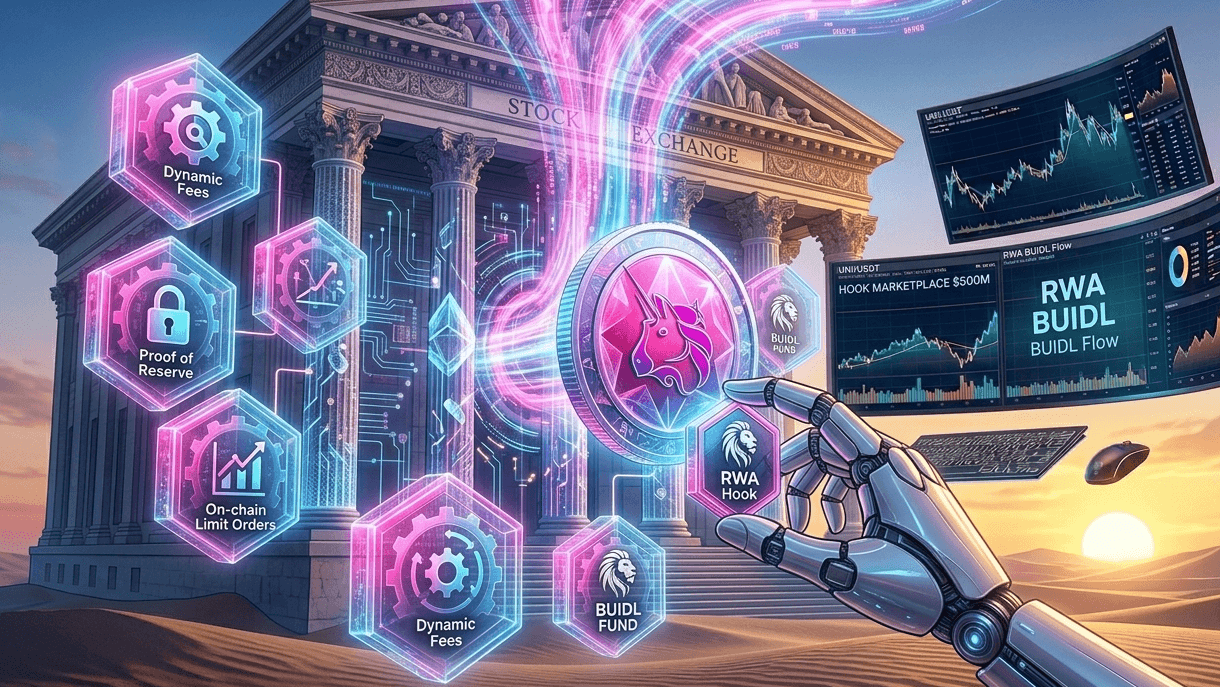
Hooks are "plugins" that allow external smart contracts to execute custom logic at specific points in a liquidity pool's lifecycle (e.g., before or after swaps, or during liquidity additions/removals).
For example, Hooks can enable the following:
| Hook Use Case | What it can do |
| Dynamic Fees | Automatically adjust fees based on market volatility to reduce losses for liquidity providers |
| On-chain Limit Orders | Execute limit orders on the DEX, such as "buy when BTC hits 95,000 USDT" |
| TWAMM (Time-Weighted AMM) | Distribute large orders over time to minimize price impact |
| Custom Oracle Integration | Incorporate external data (e.g., stock prices, interest rates) into pool logic |
Before v4, pool behavior was fixed, and adding new features required forking the protocol itself. With Hooks, near-infinite functional expansion is possible without modifying the core protocol.
v4 Architectural Improvements
Singleton Contract: While v3 had separate contracts for every pool, v4 manages all pools within a single contract. This reduces pool creation costs by approximately 99% and lowers gas fees for multi-hop swaps by up to 50%.
Flash Accounting: A mechanism that processes swaps across multiple pools by only settling the net difference, without moving tokens in the middle. This significantly improves gas efficiency.
Unichain: An Ethereum L2 developed by Uniswap that processes approximately 50% of v4 trading volume. It features sub-second block times and 95% lower fees compared to the Ethereum mainnet, with over 20 protocols already operating on it, including Circle, Coinbase, and Lido.
Key Trends in 2026
Launch of the Hooks Marketplace and $500 Million Liquidity Program
In April 2026, the Uniswap Foundation officially launched the Hooks Marketplace. It is a platform where developers can publish and discover Hooks, supported by a $500 million liquidity incentive program. Within 24 hours of launch, it attracted $3.4 billion in new TVL, and over 2,500 custom pools are now operating on v4.
Integration with BlackRock BUIDL
In February 2026, UniswapX enabled on-chain trading for BlackRock's tokenized fund, BUIDL. UniswapX is a protocol that automatically searches for the best prices without gas fees, and its backend utilizes v4 Hooks to find optimal routes across multiple pools. This integration allows RWA products issued by the world's largest asset manager to be traded on a DEX, further blurring the lines between DeFi and traditional finance.
Dismissal of Class Action Lawsuit
In March 2026, a U.S. federal court dismissed all class action lawsuits against Uniswap Labs. The ruling that a DEX protocol is not considered an "unregistered seller of securities" serves as a significant legal precedent for the entire DeFi protocol space.
UNI Burn Initiation and Tokenomics Overhaul
With the fee switch activated in December 2025, 17% of swap fees are allocated to UNI buybacks and burns. Additionally, sequencer fees on Unichain are connected to the same burn mechanism, ensuring that protocol usage directly translates into deflationary pressure on UNI.
New Experiments Born from Hooks: Unipeg (uPEG)
One experimental project symbolizing the potential of v4 Hooks is Unipeg (uPEG). It features a mechanism where a 24x24 pixel unicorn SVG image is automatically generated on-chain every time a swap occurs, based on the concept that "the act of trading creates art."
Unipeg gained attention not as an investment target, but as a demonstration of how deeply swap behavior can be customized via Hooks. It embodies the direction of v4 by showing the potential for a new intersection between NFTs and DeFi. However, as it is an experimental project, please exercise sufficient caution regarding investment.
Trading UNI on WEEX
WEEX supports both UNI/USDT spot trading and UNI/USDT futures trading. You can trade based on medium- to long-term fundamentals linked to the expansion of Uniswap v4, UNI burns via the fee switch, and institutional entry. When using futures, please ensure you set TP/SL (Take Profit/Stop Loss) orders.
Conclusion
Uniswap v4 represents a shift from a "fixed DEX" to a "programmable liquidity infrastructure" that anyone can customize. With Hooks enabling infinite functional expansion such as dynamic fees, limit orders, and RWA integration, 2026 has become a year where the foundation for institutional entry and legal stability has been established, alongside the BlackRock BUIDL integration and the start of UNI burns.
Frequently Asked Questions
Q. What are the benefits of holding UNI tokens?
UNI is the governance token for Uniswap and holds voting rights for key protocol decisions. Since December 2025, the fee switch has been active, and a portion of swap fees is used for UNI buybacks and burns, meaning the scarcity of UNI increases as protocol usage grows. Note that UNI staking on Unichain (for validator rewards) is a feature specific to Uniswap's own chain. WEEX focuses on UNI spot and futures trading.
Q. What are the risks of Hooks?
Because Hooks are external smart contracts, security risks can arise depending on the quality of their implementation. The Uniswap Foundation operates a security fund to review the safety of Hooks, but not all Hooks are audited. When providing liquidity to a pool that incorporates new Hooks, it is important to verify whether those Hooks are from a trusted developer.
Q. What is the difference between Uniswap v4 and a CEX (Centralized Exchange)?
CEXs manage user assets and conduct trades using an order book system. In contrast, Uniswap v4 operates via smart contracts, and users trade directly from their own wallets. Since there is no intermediary, it is free from the risks of CEX hacking or bankruptcy, though it carries smart contract risks and gas fees. With v4 Hooks, features previously found only on CEXs, such as limit orders, can now be realized on a DEX.

Disclaimer
WEEX and its affiliates provide digital asset exchange services, including derivatives and margin trading, only to eligible users in legally permitted regions. This content is for general information purposes only and does not constitute investment advice. Please consult with a professional before trading. Cryptocurrency trading involves high risk, and you may lose all of your invested funds. By using WEEX services, you are deemed to have agreed to all relevant risks, Terms of Service, and Risk Disclosure. Please exercise your own judgment and invest only what you can afford to lose.