The Best Crypto Trading Strategy in 2025

Key Takeaways
- Choose your trading strategy consciously: Day trading (active daily monitoring), scalping (high-frequency trading), or swing trading (more relaxed holding periods) – one must fit your lifestyle.
- Risk management is non-negotiable: Risk a maximum of 1–2% of your trading capital per trade, always use stop-loss orders, and define profit targets in advance.
- Learn the basic indicators: RSI, MACD, and Bollinger Bands are your most important analysis tools – do not use more than three at the same time.
- Choose the right trading platform: Speed, low fees, high liquidity, and security are non-negotiable.
- Start small and document everything: Begin with demo accounts and mini positions (50–100 USD), analyze every trade, and learn continuously.
Introduction
How do you choose the right crypto trading strategy when you are just starting out? Day trading, scalping, or swing trading – each strategy has different requirements for time, risk appetite, and technical knowledge. This guide compares the three most important short-term trading approaches for 2026, explains their pros and cons, and shows you which strategy fits your lifestyle.
You will learn how professional traders work with technical indicators like RSI and MACD, which risk management fundamentals are non-negotiable, and which typical beginner mistakes can destroy your capital. The crypto market offers unprecedented liquidity in 2026 with over 1,700 tradable coins and 24/7 trading hours – but without a structured strategy, loss is guaranteed.

What is Day Trading?
Day trading in the crypto market means opening and closing positions within minutes to hours. The decisive advantage: Since crypto markets trade around the clock, new trading opportunities constantly arise. Day traders use technical indicators like the RSI (Relative Strength Index) and the MACD (Moving Average Convergence Divergence) to identify entry points.
The strategy works particularly well during high market volatility – a typical characteristic of cryptocurrencies.
How Day Trading Works
Traders observe price trends within a day, buy during an upward movement, and sell before the correction occurs. This requires constant monitoring and access to a platform with fast order execution and low fees.
Popular day trading techniques are:
- Momentum trading: Buying high-performing assets
- Breakout trading: Opening a position when the price breaks through resistance or support levels
- Support-resistance trading: Buying at support, selling at resistance
Requirements for Successful Day Traders
- Access to professional technical analysis tools with real-time charts and technical indicators
- A stock of discipline and emotional control – FOMO and panic are the main killers
- Good understanding of chart patterns and market psychology
- Risk budget of a maximum of 1–2% per trade to avoid blowups
- Fast internet connection and stable trading platform without downtime
What is Scalping?
Scalping is the most aggressive and stressful short-term trading strategy. Scalpers perform dozens to hundreds of trades per day – each with a minimal but consistent profit target. A scalp trade often lasts only a few seconds to 5 minutes and exploits even the smallest price differences.
The principle: Many small profits add up to large returns, but a series of small mistakes or high fees can quickly consume them.
The Top 3 Scalping Techniques for 2026
1. Range Trading (Consolidation Trading)
Identify a price consolidation range – for example, Bitcoin between 40,000–41,000 USD or an altcoin between 1.00–1.05 USD. Buy at the lower boundary (support level), sell at the upper (resistance level). Repeat this in short cycles until the range breaks out upward or downward. This technique works best in sideways moving markets.
2. RSI + Bollinger Bands Combination
Use the RSI above 70 (overbought signal) as a sell signal and below 30 (oversold signal) as a buy signal. Confirm with Bollinger Bands: Sell when the price touches the upper band; buy at the lower band. This combination minimizes false signals during unexpected market movements.
3. Breakout Scalping (Breakout Trading)
Wait for a tight price consolidation (e.g., a 15-minute range for Bitcoin with only a 100 USD spread). Enter a trade when the price breaks out of this range with high volume. Most scalpers focus on the first 30 seconds after the breakout, as that is where the highest momentum energy lies.
Critical Requirements for Scalpers
- Access to an exchange with low fees and highest liquidity – WEEX is optimal for this
- Fast internet connection (under 100ms latency is ideal) and stable trading platform without lags
- Automatic stop-loss orders to avoid blowups (emotions have no place in 5 seconds)
- Detailed understanding of order books and volume data – scalpers read the "big money"
- Psychological stability under extreme stress – multiple trades per minute require nerves of steel
Warning: Scalping is associated with the highest error rate. Transaction fees can consume profits if you do not remain disciplined.
What is Swing Trading?
If day trading and scalping are too stressful, swing trading is a viable and more profitable alternative for most beginners. Swing traders hold positions for days to weeks to profit from medium-term price movements.
The decisive advantage: You need less daily monitoring and have more time to think rationally – emotions cannot build up as quickly. Swing trading combines technical analysis with patience, and the market rewards patience in the long term.
How Swing Trading Works
Traders use moving averages like the 20, 50, and 200 averages as well as Fibonacci retracements to identify resistance and support levels.
The swing trading principle:
When an asset rises above an important average (bullish signal), a position is opened. The position is held for days or weeks while you wait for a clear profit target (e.g., +10–15%) or a defined stop-loss. Unlike day traders, swing traders sleep peacefully while their trade is running – no 24/7 monitoring necessary.
Comparison: Which Strategy Fits You?
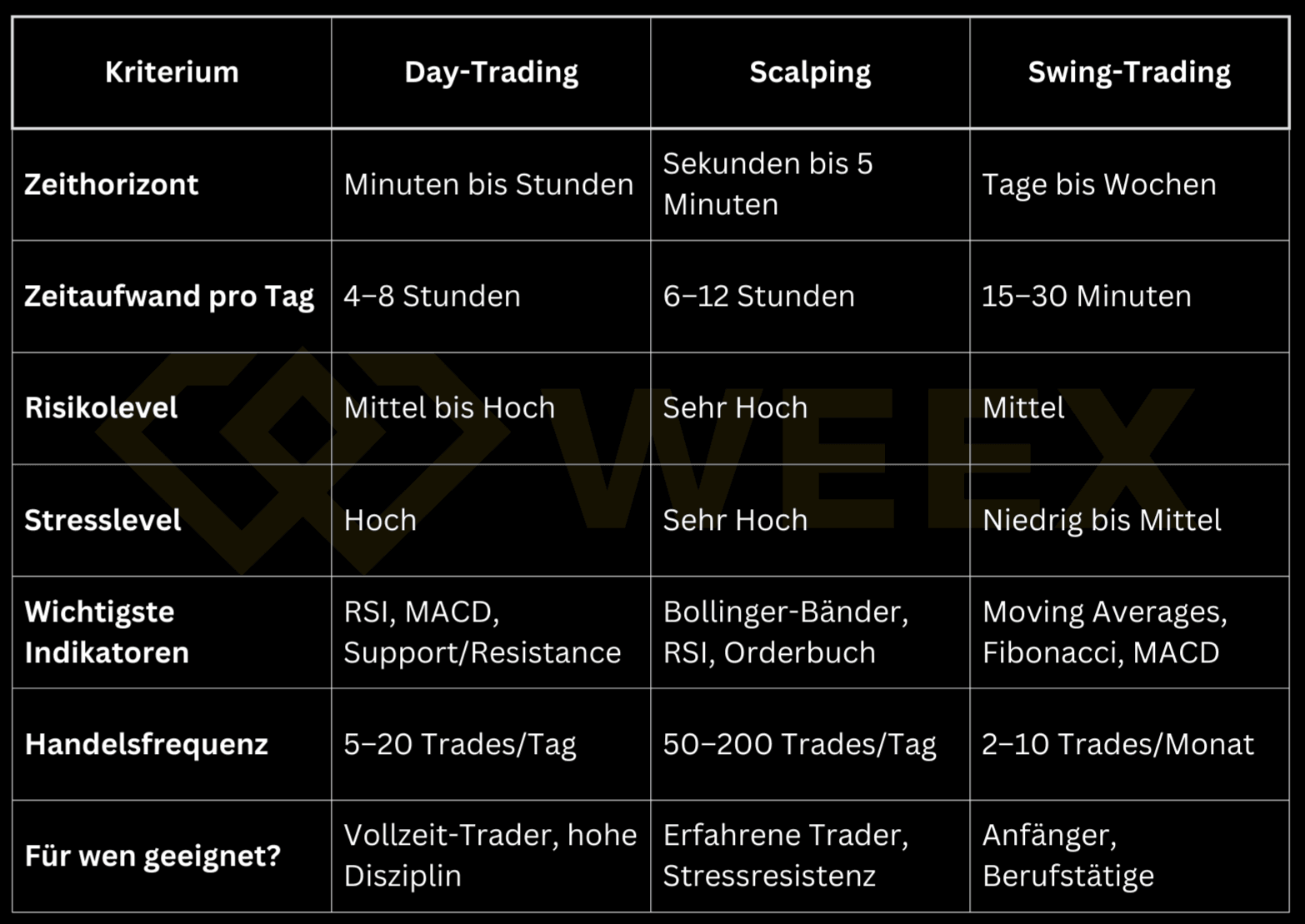
Which strategy fits you?
- If you have to work full-time → Swing trading
- If you have 4+ hours/day of time → Day trading
- Scalping only for experienced traders with high stress tolerance
Risk Management: The 4 Basic Rules
The best strategy is worthless without risk management. In the volatile crypto market, individual mistakes can destroy your entire capital. A single trade with 10x leverage and the wrong direction can wipe out your entire account – that is why risk management is not optional, but absolutely essential.
1. Position Sizing (The 1–2% Rule)
Never risk more than 1–2% of your trading capital in a single trade. Example: If your account is 1,000 USD, risk a maximum of 10–20 USD per trade. This rule protects you from ruin – even a series of 10 lost trades only costs you 10–20% of your capital, not 100%.
2. Stop-Loss Orders (Your Insurance)
Define a price level before the trade where you automatically exit – no matter how much your inner dialogue complains. Example: You buy Bitcoin at 42,000 USD with a stop-loss at 40,000 USD. This limits your loss to 2,000 USD per contract. Stop-loss orders must be automated – emotional decisions lead to 90% of all blowups here.
3. Diversification (Don't put all your eggs in one basket)
Distribute your portfolio across several coins, timeframes, and trading strategies. Do not focus on a single coin – even if Bitcoin or Ethereum crashes, your portfolio remains stable. Good diversification means: 5–10 different trades in parallel, not 20+ (overtrading leads to losses).
4. Take-Profit Targets (Realize your profits)
Define when you will realize the profit target – not by gut feeling, but by plan. Example: "I sell 50% of the position at +5% profit and trail the remaining 50% at +10%." This technique (partial profit taking) protects you from "profits turning into losses" scenarios.
A 2:1 risk-reward ratio means: You risk 100 USD for 200 USD profit – statistically profitable from a 40% win rate.
Technical Indicators for Beginners
The right combination of technical indicators is the difference between professionals and beginners who trade blindly.
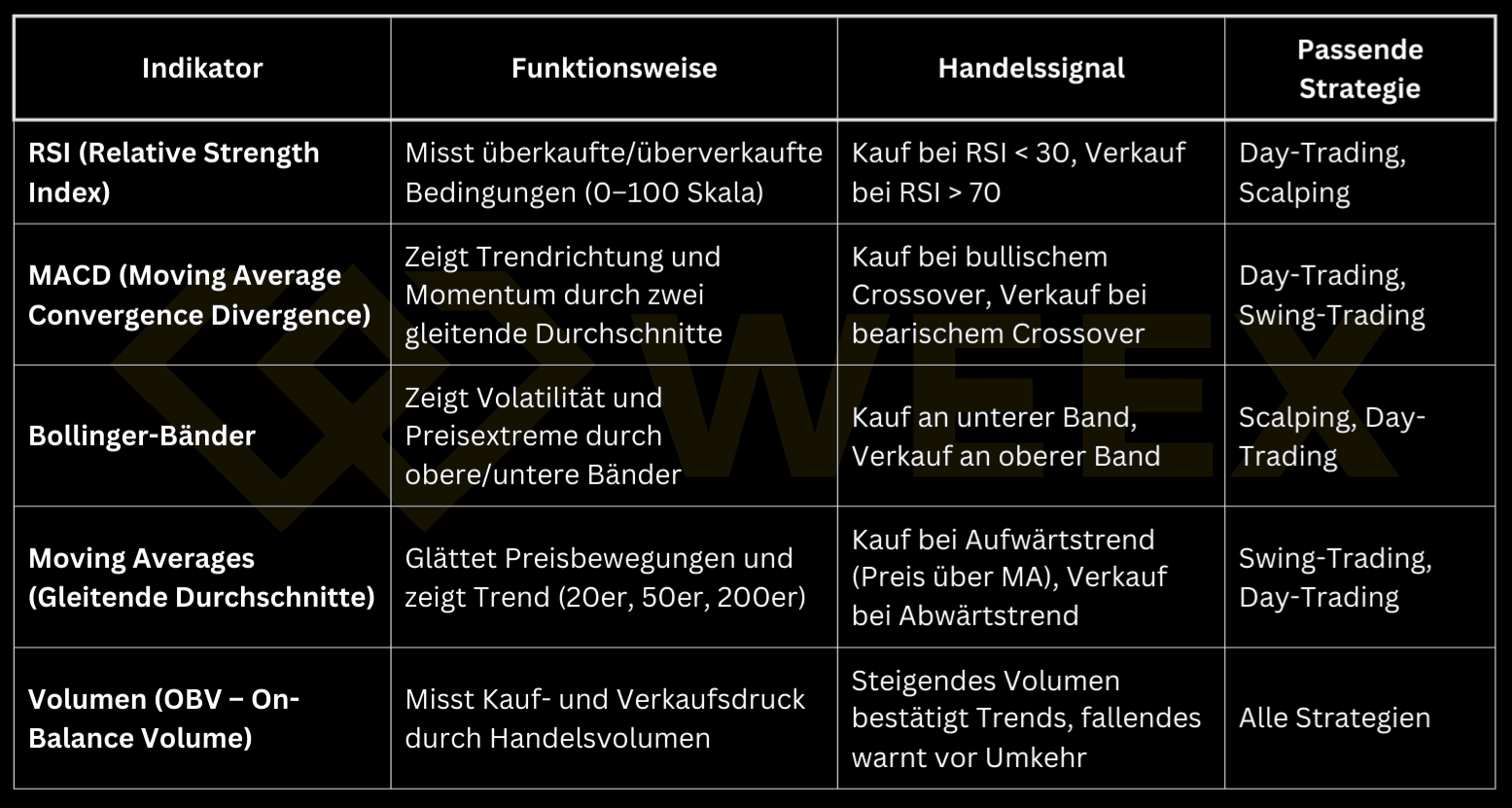
Beginner tip: Do not use more than 3 indicators at the same time. Too many create over-analysis, paralysis by analysis, and false signals that lead to poorly timed trades.
A classic and proven combination: Moving average (as trend) + RSI (as entry) + volume (as confirmation).
How to Choose the Right Trading Platform
For successful crypto trading in 2026, the right trading platform is critical. The exchange is your tool – a bad tool leads to expensive mistakes (slippage, fees, downtime).
Top Requirements for a Trading Exchange
- Fast order execution (< 100ms latency) – essential for day trading and scalping to minimize slippage
- Low fees (0.01–0.1% maker, 0.1–0.2% taker) – especially important for scalping, as fees consume profits
- High liquidity – enables fast entry and exit without large price differences
- Advanced charts & indicators – built-in technical analysis without external tools
- Security – 2FA authentication, cold storage of assets, regulated and licensed
- 24/7 support – for emergency situations and technical problems
You get all this at WEEX. Register now!
5 Critical Beginner Mistakes (and how to avoid them)
The most common beginner mistakes in crypto trading are systematic and avoidable.
1. FOMO Trading (Fear of Missing Out)
Many beginners buy because other coins are "rising fast" – without technical analysis or strategy. Example: Bitcoin rises 2,000 USD in an hour, so you have to enter NOW, right? Wrong.
Solution: Stick to your defined strategy; trade only on clear technical signals according to your indicators. Avoid emotional decisions at 3 AM.
2. Trading without a Stop-Loss
The classic "this loss will recover" mindset leads to ruin. A normal 5% loss becomes 50%, then 100% – your entire account is gone.
Solution: ALWAYS set a stop-loss before the trade – no exceptions. Automation protects you from yourself.
3. Too High Leverage
10x leverage at 1% price drop = 10% loss. 100x leverage at 1% price drop = entire account gone. Beginners use leverage because they want to "get rich quick" – that is the most expensive mental mistake of all.
Solution: Beginners should trade without leverage or a maximum of 2x. Only consider using leverage after 6–12 months of experience and proven profitability.
4. Too Large Position Size
Putting all capital into one trade. A single mistake = ruin.
Solution: 1–2% risk per trade = maximum security and long-term survival.
5. Emotional Trading
Panic selling on red candles, panic selling on FUD (fear, uncertainty, doubt), unjustified FOMO on green candles. Emotions are the trader's enemy.
Solution: Use automation (stop-loss, take-profit) to remove emotions from the equation. A mechanical strategy always beats emotional trading.
Conclusion
The crypto market in 2026 rewards those who act in a disciplined, patient, and strategic manner. Emotional trading leads to 90% of all losses – make yourself the exception through systematic thinking.
Concrete next steps:
- Open a demo account at WEEX (free, risk-free) and practice for 2–4 weeks without real money
- Start with mini positions (e.g., 50–100 USD) for 2–3 weeks and trade with real money, but minimal emotional burden. Document every trade – entry time, reason for the trade, outcome, what went well, what went wrong. This journal is your learning tool
- Use authoritative data sources like CoinMarketCap or CoinGecko for objective market data
The best crypto trading strategy in 2026 is not the most complicated one, but the one you can implement consistently. Start simple (moving average + RSI), master it, then expand. Your discipline and emotional control are the only true indicators for long-term success in crypto trading.
FAQ – Frequently Asked Questions
Which strategy is best suited for beginners?
Swing trading requires less monitoring and allows for more rational decisions than day trading. With 15–30 minutes of daily analysis, you learn faster than with scalping.
How much capital should I have to start?
At least 500–1,000 USD to trade practically with 1–2% position sizes. With 100 USD, every trade is worthless; with 10,000 USD, you become too emotional.
Should I use leverage?
No, not as a beginner. With leverage, profits AND losses double – the mathematical odds are against you. Only consider it after 1 year of experience.
Which timeframes are most profitable?
No general answer – depends on your discipline. Day trading: 15–60min charts. Scalping: 1–5min charts. Swing trading: 1h to daily charts. Longer = more relaxed, shorter = more stressful.
How long does it take to become profitable?
On average 6–12 months with consistent learning, discipline, and documentation. Without a mindset shift and emotional control: several years or never.
Which coins should I trade?
Start with the top 10 coins (Bitcoin, Ethereum, BNB, XRP) – these have the highest liquidity and less risk of manipulation. Altcoins are more volatile but riskier for beginners.
Is crypto trading realistically profitable?
Yes, if you stick to risk management, discipline, and a clear strategy. 90% of beginners lose money because they ignore these fundamentals.
WEEX | Rising Star of Crypto Exchanges in the DACH Region
WEEX combines security, innovation, and community with features for beginners and pros:
Security & Protection
- 1,000 BTC Protection Fund: Self-funded fund for quick loss protection in exceptional cases
Trading & Earning
- Auto Earn: Daily automatic USDT earnings without effort
- Copy Trading: Follow elite traders automatically or apply as an elite trader for additional benefits
- WE-Launch: Early access to new projects – exclusive for WEEX users
Benefits & Rewards
- Promotions & Rewards: Trading competitions and special bonuses for active users
- Affiliate Program: Lifetime commissions from new users – details here
- VIP Benefits: Lowest fees, market insights, and personal support for high-volume traders
- WXT Token: Fee discounts, airdrops, and exclusive platform benefits
Discover current trends on WEEX Spot and start now: Register now
Disclaimer – Legal Notice from the WEEX Exchange
WEEX and its affiliates offer services for the exchange of digital assets, including derivatives and margin trading, only where legal and for eligible users. All content is general information, not financial advice – seek independent advice before trading. Trading cryptocurrencies is associated with high risk and can lead to a total loss. By using the services of WEEX, you accept all associated risks and conditions. Never invest more than you can afford to lose. Further information can be found in our Terms of Use and in the Risk Disclosure.