MiCA Explained: EU Crypto Regulation, Obligations & Deadlines until 2026

Key Takeaways
- MiCA is real and binding: Since December 30, 2024, MiCA applies to the entire European crypto market – there is no opt-out.
- Time is running out: Crypto Asset Service Providers (CASPs) and issuers have until June 30, 2026, to obtain their licensing.
- Regulation builds trust: MiCA ensures uniform rules and strengthens Europe as a crypto hub in the long term.
- Compliance is an investment: Properly implementing MiCA processes reduces risks and secures competitiveness.
- Costs of inaction: Violations of MiCA are sanctioned with 1–10% of annual turnover or up to €5 million (!).
Introduction: Why MiCA is relevant now
European authorities have responded to the crypto industry boom: The Markets in Crypto-Assets Regulation (MiCA) creates uniform rules of the game for all member states for the first time. Since its adoption in April 2023 and the start of its application in June 2023, it has been clear: MiCA is mandatory for the industry.
The central question crypto companies are asking themselves: Am I affected – and how do I prepare my business for full compliance by July 2026 at the latest?

What is MiCA? The basics
MiCA regulates for the first time EU-wide who can offer crypto services and under what conditions crypto assets can be issued. Particularly relevant: The regulation affects anyone addressing customers in Europe – regardless of where the company is formally based. Even a US player reaching German users must meet the requirements.
MiCA pursues four core objectives:
- Investor protection: End customers should be protected from fraud and scandals like FTX or LUNA.
- Market integrity: Manipulation and abuse are made more difficult EU-wide.
- System stability: Systemically important stablecoins are monitored.
- Innovation promotion: Clear rules instead of bans, so that serious projects can emerge.
Uniformity will replace the patchwork of individual countries in the future, making the European crypto market more attractive for global players.
Which crypto assets are affected?
MiCA distinguishes between three asset categories:
E-Money Tokens (EMTs): The strictest stablecoins
EMTs are tokens pegged to a single currency (e.g., EUR, USD). The requirements:
- 1:1 backing: Every token must be fully secured by fiat.
- 30% minimum reserve in bank accounts: The rest in government bonds & money market funds.
- Licensing obligation as an e-money institution, comprehensible governance setup, redemption guarantee for holders.
- Audited reserves: Regular, external audits.
- Effectively prohibited: Algorithmic stablecoins and constructions without "real" backing.
Examples: A euro-denominated stablecoin like EURC or regulated variants of USDC.
Asset-Referenced Tokens (ARTs): Multi-asset stablecoins
ARTs are backed by a basket of currencies or assets such as USD+EUR+Gold. The following applies here:
- Authorization required for issuance, issuers must be based in the EU.
- Whitepaper must be approved by a regulator such as BaFin.
- Higher liquidity and diversification requirements for the reserve.
Other crypto assets (Utility & Payment Tokens)
Tokens like Bitcoin, Ethereum, and utility tokens are subject to less stringent requirements, but:
- Public Offering: Whitepaper must be published, warning notices for consumers.
- 14-day right of withdrawal for buyers in the case of new listings in the EU.
Not regulated by MiCA: Individual NFTs, decentralized DAOs (truly decentralized), and pure peer-to-peer transactions.
Who must implement MiCA?
Crypto Asset Service Providers (CASPs)
CASPs are defined as all those who provide the following services for third parties:
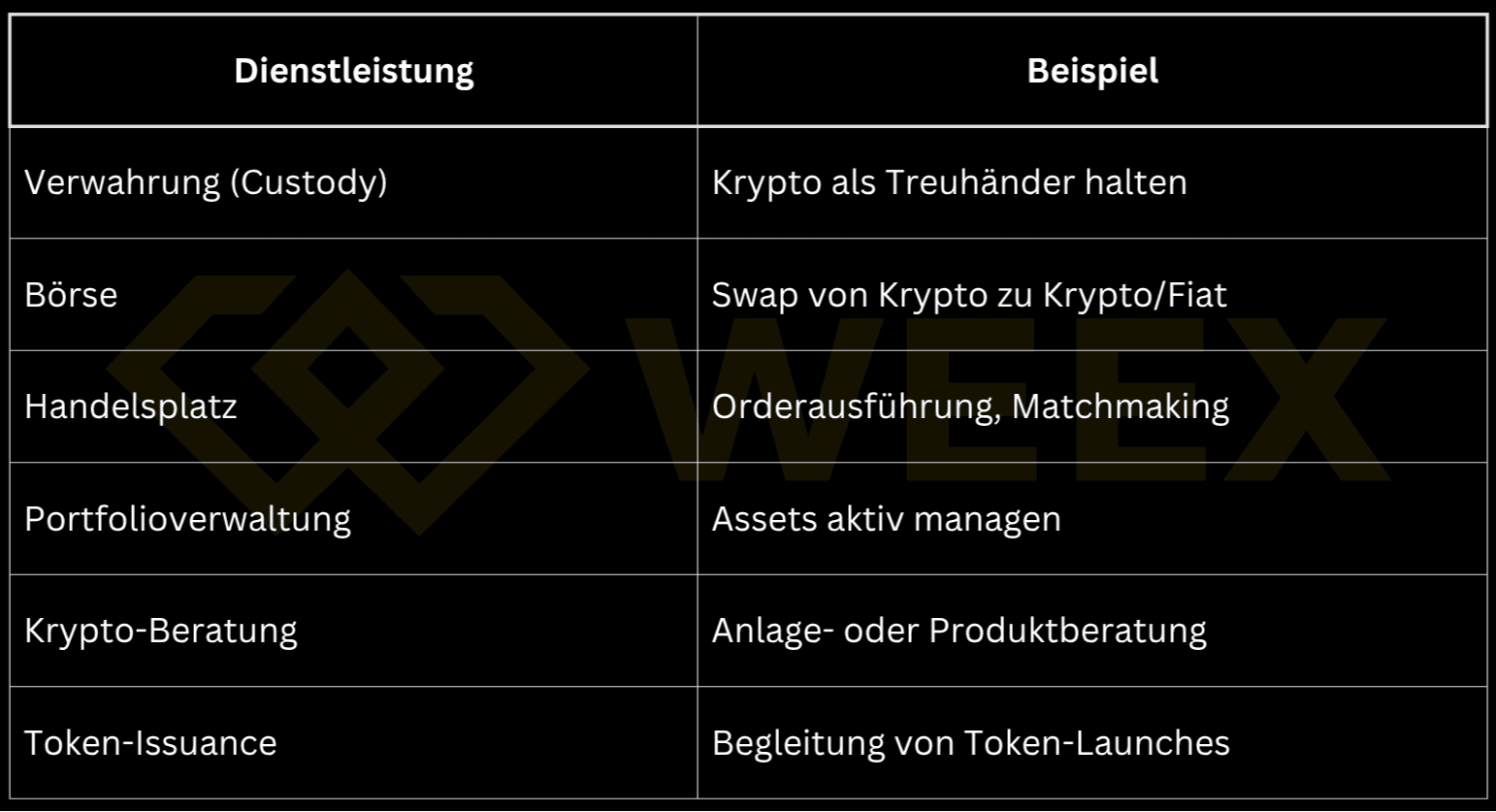
Required for all: Licensing, an office located in the EU, comprehensive AML and KYC processes, as well as solid capital and governance structures.
Token issuers
Anyone offering crypto assets publicly (regardless of whether it is a stablecoin, utility, or others) must meet strict whitepaper and registration requirements. ARTs/EMTs require additional authorization.
Special cases & exceptions
- Self-hosted wallets: Not affected if used purely privately.
- DAOs/DeFi: Only truly decentralized models are exempt – in cases of doubt, it is better to seek legal advice.
Central MiCA requirements for companies
Licensing and registration obligations
From January 2025, CASPs can submit their license applications to national authorities; for Germany, this is BaFin. Required:
- Identity and reliability check of management
- Detailed business plan & proof of capital
- Complete governance structures incl. compliance officer and risk manager
Timeline:
- Submit license application in time (by mid-2026 at the latest!)
- Transitional period applies for existing entities until then.
Anti-Money Laundering (AML) & Know-Your-Customer (KYC)
MiCA sets new standards:
- Identify customer (incl. ID/selfie)
- Clarify beneficial owners
- Check sources of funds
- Report every suspicious transaction directly
Violations are costly – up to 10% of turnover or €5 million in fines.
Governance & capital adequacy
- Compliance officer and risk manager mandatory
- Min. €50,000 equity (for custody: €500,000+)
- Professional indemnity insurance
Whitepaper & token processes
Anyone issuing tokens publicly needs a compliant whitepaper with:
- Clear project and token description
- Risk and technology disclosures
- 20 working days lead time for registration with the regulator (BaFin etc.)
Stablecoin special rules
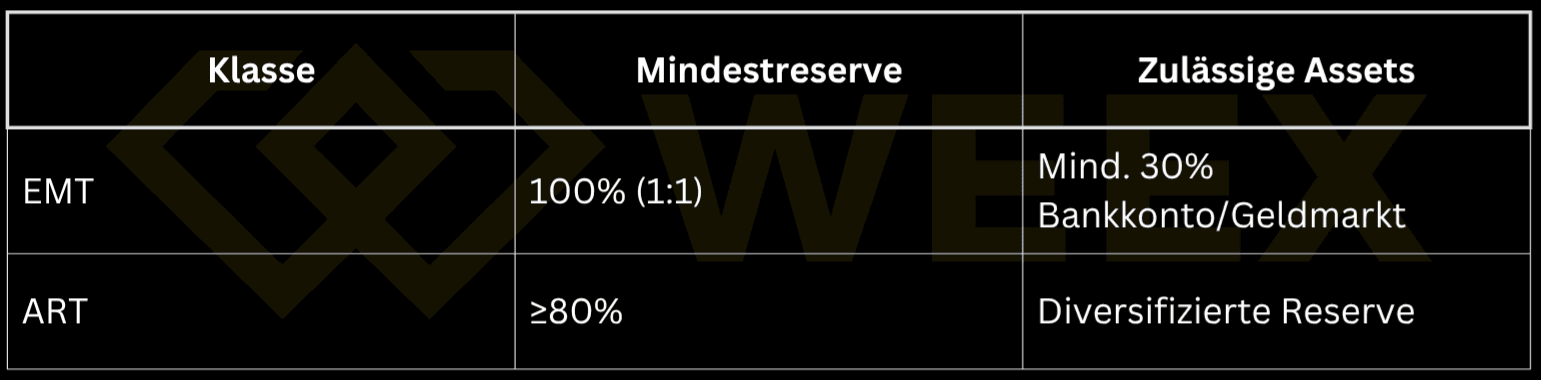
Free and prompt redemption possibility for holders is mandatory.
Roadmap: MiCA implementation phases until 2026
- Phase 1 (June 2023): MiCA enters into force, standards are written
- Phase 2 (June 2024): EMT/ART rules binding, all issuers must be compliant
- Phase 3 (Dec 2024): CASP licenses can be applied for, TFR enters into force (all transfers with sender/recipient data)
- Phase 4 (until June 2026): Transitional period ends – by now at the latest, every relevant company needs its license
Common mistakes & their avoidance
- Lack of self-assessment: Anyone managing customer assets is almost always regulated (better to clarify with experts).
- KYC too superficial: Failing to meet minimum requirements leads to rejection.
- Underestimating deadlines: Demand for licenses is rising – better to start 6-12 months earlier.
- Technical backlog with TFR: Pay attention to interfaces and compliance in time.
Industry consequences
Exchanges & trading platforms
Advantage: A European license passport and more trust for investors Disadvantage: Significantly rising compliance costs, small providers might not be able to afford this.
Stablecoin providers
Existing products must improve and get approved as EMT/ART (see current info on CoinMarketCap). Without an EU license, market exclusion is imminent.
Wallet and custody providers
Only pure self-custody solutions remain unregulated. As soon as third-party private keys are managed (custodial wallets), MiCA applies.
Compliance checklist: 5 steps to implementation
- Conduct self-assessment: Am I a CASP/issuer? Use the checklist and glossary on the internal page.
- Build governance: Define responsible persons and guidelines in writing (AML, KYC, IT).
- IT systems & infrastructure: Integrate KYC platform, prepare TFR API, implement security concepts.
- Activate KYC/AML: Test processes, train employees, set up reporting.
- Apply for license: Submit all documents to the national authority (e.g., BaFin) at an early stage.
Conclusion: Take action now!
MiCA is not a ghost of the future, but reality. Companies that prepare comprehensively gain legal certainty, growing trust among institutional clients, and a long-term competitive advantage.
The message is clear: Act now ‒ do not wait!
FAQ: Frequently Asked Questions
Does my company have to comply with MiCA if we only have non-EU customers?
No, as long as no EU customers are served ‒ but "EU customers" are everyone with residence/company in the EU.
Is Bitcoin regulated under MiCA?
Only when trading via platforms and in custodial wallet management, not in private self-custody.
What happens if we do not get a license by June 30, 2026?
Operations are prohibited, accounts can be frozen, fines are threatened.
Are purely decentralized DAOs affected?
Only if they are completely decentralized (without central control) – this is rare and should be legally checked.
Do lending/staking protocols have to follow MiCA?
If customer assets are managed: Yes. With pure interface and self-custody: possibly no.
About WEEX | The rising star of crypto exchanges in the DACH region
WEEX combines security, innovation, and community with a wide range of features for beginners and professionals:
- 1,000 BTC Protection Fund: The security of our users is our top priority. WEEX offers its own self-financed protection fund with 1,000 BTC, which covers losses of our users quickly and efficiently in exceptional cases – for maximum protection during trading!
- Auto Earn: Secure daily returns on your USDT with Auto Earn – completely automatically and without effort.
- WE-Launch: Early access to new, promising projects and tokens – exclusively for WEEX users as a thank you.
- Promotions & Rewards: Regular promotions, trading competitions, and special bonuses await active users.
- Affiliate Program: Earn commissions by bringing new users to WEEX – transparent, fair, and direct. Earn for life from their trading on WEEX!
► All info at WEEX Affiliate
- VIP Benefits: Frequent traders & WXT holders benefit from the lowest fees, exclusive market insights, and personal support.
- WXT Token: With the WEEX-native token, traders benefit from discounted fees, airdrops, and exclusive platform advantages. The potential of WXT is immense!
- Copy Trading: Follow elite traders and copy their strategies automatically. Particularly ambitious traders can apply as an elite trader and receive additional benefits as well as the opportunity to profit from their followers.
► Apply now as an elite trader for WEEX Copy Trading
Find out about current coin trends and trading opportunities on WEEX Spot as well as all benefits and innovations regarding crypto trading on WEEX.
Test WEEX now and benefit from maximum security, innovative trading features, and a strong community!
Disclaimer – Legal notice from the WEEX exchange
WEEX and its affiliates offer services for the exchange of digital assets, including derivatives and margin trading, only where they are legal and for eligible users. All content is general information, not financial advice - seek independent advice before trading. Trading cryptocurrencies involves a high risk and can lead to a total loss. By using the services of WEEX, you accept all associated risks and conditions. Never invest more than you can afford to lose. Further information can be found in our Terms of Use and in the Risk Disclosure.