
Margin Liquidation Price: Adjustments in Leverage Trading

Key Takeaways
- Margin adjustment directly controls liquidation price: More margin lowers liquidation risk for long positions and increases the safety buffer for short positions
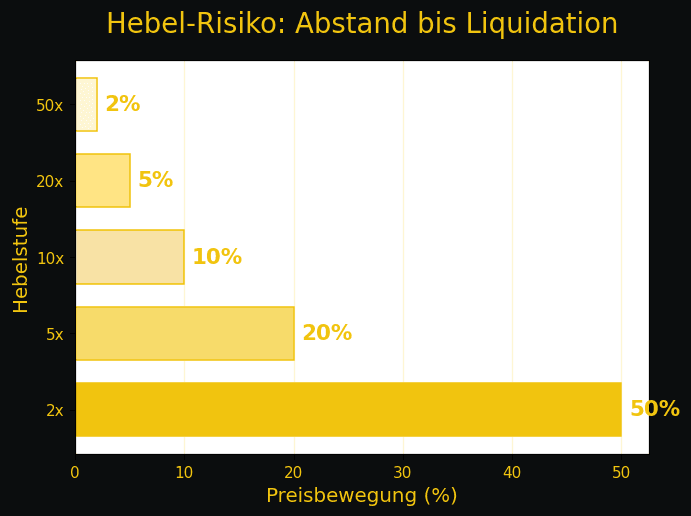
- Leverage selection is crucial: 10x leverage means a 10% price movement to liquidation – higher leverage = tighter safety buffer
- Master the practical formula: Liquidation price = (Margin ± Position Value/Entry Price) ÷ Position Size
- Risk management tools are mandatory: Stop-loss orders, position sizing (max. 1-2% per trade), and continuous monitoring
- Plan for volatility: Maintain a sufficient margin buffer in crypto markets to withstand price fluctuations
Introduction
How does adjusting your margin affect the liquidation price – and why is this critical for your trading survival?
In leverage trading with leveraged products like crypto futures, the liquidation price is your most important protection mechanism: it marks the critical point at which your position is automatically closed to prevent further losses.
The good news: You are in control!
Through strategic margin adjustments, you can actively manage this liquidation price, gain more breathing room, and protect your capital simultaneously.
In this comprehensive guide, we show you step-by-step how margin changes influence your liquidation price – with concrete calculation examples, practical formulas, and proven risk management strategies for long and short positions.

What is the Liquidation Price? – Understanding the Basics
Definition: Liquidation Price as a Safety Net
Think of your liquidation price as an automatic safety net.
If the market moves too far against your trade and your margin can no longer cover potential losses, the exchange automatically closes your position to protect you from losing more money.
The liquidation price is therefore the critical price point at which your margin falls below the required maintenance margin level.
Why are positions liquidated?
Liquidation serves to protect both the trader and the exchange.
In leverage trading, the platform lends you capital – if your position falls below a certain value, you would theoretically lose more than your deposit.
Automatic liquidation stops this before debt is incurred (in the EU, there is generally no obligation to provide additional funding on regulated exchanges).
The difference between margin and liquidation price
Margin is your collateral – the capital you deposit to open a leveraged position.
Liquidation price is the market price at which your margin is exhausted and the position is forcibly closed.
Practical example: With $1,000 margin and 10x leverage, you control a $10,000 position – your liquidation price is where your $1,000 loss is completely wiped out.
Margin Adjustment: How to Influence Your Liquidation Price
Adding margin: More security in a volatile market
By adding additional margin, you gain a larger safety buffer.
For long positions, the liquidation price is shifted downward – the market can fall further before you are liquidated.
For short positions, the liquidation price shifts upward – the price can rise more without endangering your position.
Practical benefit: In highly volatile crypto markets (Bitcoin often fluctuates ±5% daily), additional margin prevents normal price movements from knocking you out of your position.
Reducing margin: Risks and opportunities
Withdrawing margin capital frees up funds for other trades, but significantly increases your liquidation risk.
The liquidation price moves closer to the current market price – even small price movements can lead to forced liquidation.
For further knowledge on the strategy between cross-margin and isolated-margin, we recommend studying the risk management basics in depth.
Warning: Only experienced traders should reduce margin, and even then, only with precise stop-loss orders as a backup.
The mathematical relationship between margin and liquidation price
The relationship is directly proportional and can be summarized as follows:
For long positions: More margin = lower liquidation price (more protection on the downside)
For short positions: More margin = higher liquidation price (more protection on the upside)
Rule of thumb: Each additional dollar of margin shifts your liquidation price by ($1 ÷ position size) × entry price.
Liquidation Price Formulas: Step-by-Step Calculation
Formula for long positions explained
For long positions (you are speculating on rising prices), the following applies:
Liquidation price = (Margin - (Position size ÷ Entry price)) ÷ Position size
Simplified:
LP_Long = Entry price - ((Initial margin - Maintenance margin) ÷ Position size)
When you add margin, the numerator increases and the liquidation price decreases – you have more buffer on the downside.
Formula for short positions explained
For short positions (you are speculating on falling prices), the logic is reversed:
Liquidation price = (Margin + (Position size ÷ Entry price)) ÷ Position size
Simplified:
LP_Short = Entry price + ((Initial margin - Maintenance margin) ÷ Position size)
More margin pushes the liquidation price upward – the price can rise further before liquidation occurs.
Practical calculation examples with Bitcoin
Scenario: Bitcoin price = $30,000, your margin = $1,000, leverage = 10x, position size = $10,000
Long position: LP = ($1,000 - $10,000/$30,000) ÷ $10,000 = $27,000 (liquidation at 10% decline)
Short position: LP = ($1,000 + $10,000/$30,000) ÷ $10,000 = $33,000 (liquidation at 10% increase)
Comparison table: Long vs. Short position
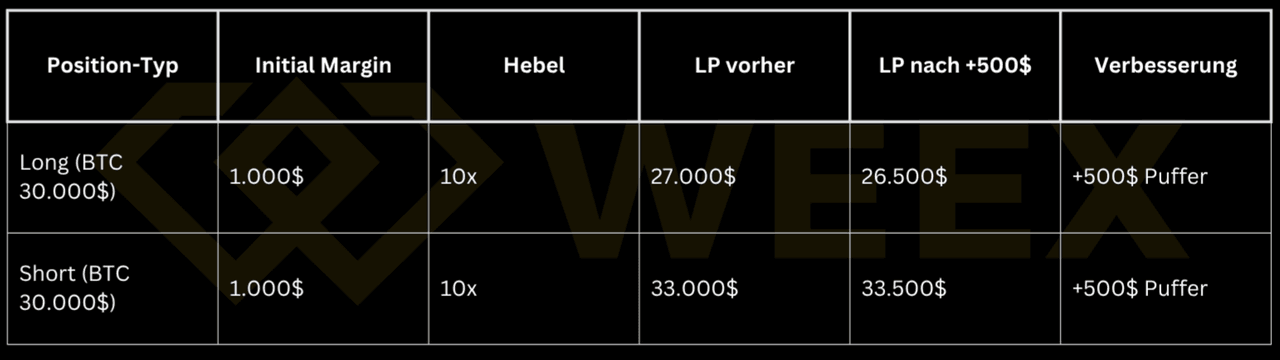
This table clearly shows how identical margin adjustments lead to opposite shifts in the liquidation price for long and short positions.
Practical Example: Adjusting Margin for a Long Position
Initial situation: 10x leverage on Bitcoin
You open a long position with the following parameters:
- Entry price: $30,000 per Bitcoin
- Initial margin: $1,000
- Leverage: 10x
- Position size: $10,000 ($1,000 × 10)
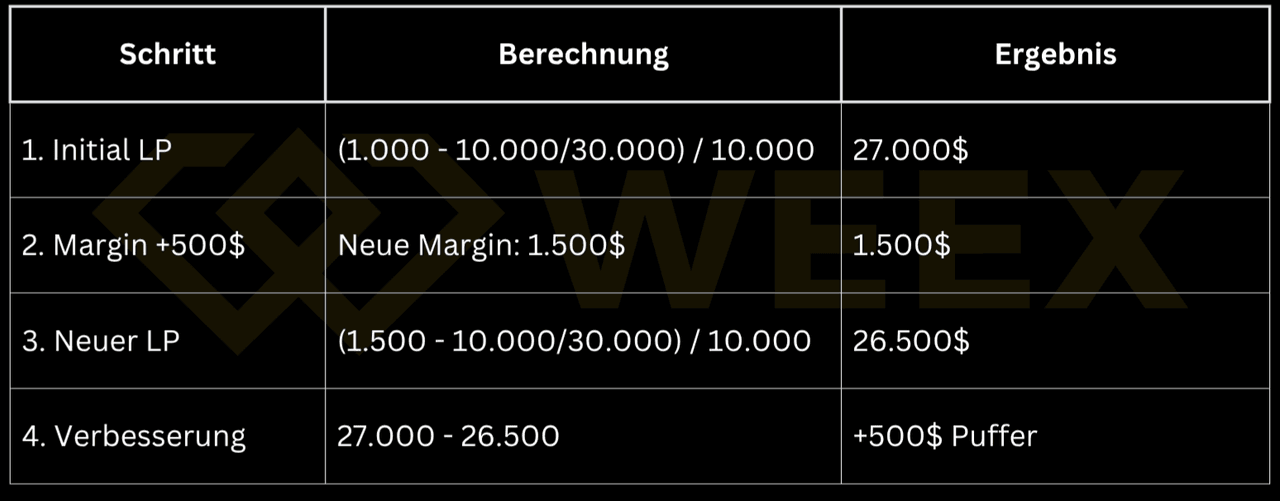
Step 1: Calculate initial liquidation price
Apply formula:
LP = ($1,000 - ($10,000 ÷ $30,000)) ÷ $10,000
Calculation:
- $10,000 ÷ $30,000 = 0.333
- $1,000 - 0.333 = 999.67
- 999.67 ÷ $10,000 = 0.09997
- 0.09997 × $30,000 (normalize) = $27,000
Your initial liquidation price is $27,000 – if Bitcoin falls by 10% (from $30,000 to $27,000), you will be liquidated.
Step 2: Add $500 margin
You decide to deposit an additional $500 as margin.
New margin: $1,000 + $500 = $1,500
All other parameters remain the same (position size $10,000, entry $30,000).
Step 3: Determine new liquidation price
Formula with new margin:
LP_new = ($1,500 - ($10,000 ÷ $30,000)) ÷ $10,000
Calculation:
- $1,500 - 0.333 = 1,499.67
- 1,499.67 ÷ $10,000 = 0.149967
- 0.149967 × $30,000 = $26,500
New liquidation price: $26,500 – your buffer has expanded downward by $500.
Step-by-step calculation
What does this mean for your risk management?
By increasing the margin, you have:
- More security: Bitcoin can now fall to $26,500 (instead of $27,000) – 1.67% additional buffer
- Better chance: To sit out short-term volatility without being liquidated
- Strategic flexibility: You can trust your market analysis for longer
Test it yourself now: Calculate your own liquidation price with professional calculators – free and without registration for quick results in real-time trading.
Practical Example: Adjusting Margin for a Short Position
Initial situation: Short position on Bitcoin
Now let's take a short position (speculation on falling prices):
- Entry price: $30,000 per Bitcoin
- Initial margin: $1,000
- Leverage: 10x
- Position size: $10,000
Calculation of initial liquidation price
Formula for short positions:
LP = ($1,000 + ($10,000 ÷ $30,000)) ÷ $10,000
Calculation:
- $10,000 ÷ $30,000 = 0.333
- $1,000 + 0.333 = 1,000.333
- 1,000.333 ÷ $10,000 = 0.1000333
- 0.1000333 × $30,000 = $33,000
Initial liquidation price: $33,000 – if Bitcoin rises by 10% (to $33,000), liquidation occurs.
Impact of margin increase
You add another $500 margin → New margin: $1,500
LP_new = ($1,500 + ($10,000 ÷ $30,000)) ÷ $10,000 = $33,500
New liquidation price: $33,500 – Bitcoin can now rise 11.67% (instead of 10%) before liquidation occurs.
Long vs. Short: The most important differences
For long positions:
- Liquidation occurs at falling prices below the entry price
- Add margin → liquidation price drops (more protection on the downside)
For short positions:
- Liquidation occurs at rising prices above the entry price
- Add margin → liquidation price rises (more protection on the upside)
Commonalities:
- Both positions benefit from additional margin through an expanded safety buffer
- The formula logic is reversed (+ instead of - in the numerator)
Risk Management: 7 Proven Tips for Managing Your Liquidation Price
1. Monitor margin levels continuously
Always keep an overview of your current margin and the distance to the liquidation price.
Set alerts if the liquidation price is less than 10% away from the current price.
Most exchanges offer push notifications – use them actively for real-time monitoring.
2. Use stop-loss orders strategically
Protect yourself by setting stop-loss orders that close your position before the liquidation price.
Rule of thumb: Place stop-loss 5-7% before the liquidation price – this way you control the exit yourself.
Stop-loss orders also avoid the liquidation fee (often 0.5-1% of the position size).
3. Choose leverage responsibly
Beginners: Maximum 2x-5x leverage – this gives you a 20-50% buffer until liquidation.
Advanced: 5x-10x leverage for medium-term positions.
Pros: 10x-20x only for short-term day trades with close monitoring.
Avoid: Leverage over 50x – even a 2% price movement against you leads to total loss.
4. Plan for volatility and create buffers
For crypto assets like Bitcoin (average ±5% daily volatility), you should keep at least a 20-30% distance from the liquidation price.
Use volatility indicators like ATR (Average True Range) to dynamically adjust your margin requirements.
Before important news (e.g., central bank decisions, Bitcoin halving), add additional margin as a buffer.
5. Diversification: Don't put all your eggs in one basket
Distribute your capital across multiple positions – maximum risk per trade: 1-2% of your total capital.
Use isolated margin instead of cross margin to limit the risk per position.
With isolated margin, only the specific position can be liquidated – other trades remain unaffected.
6. Use professional tools
Use high-quality calculators and analysis tools for precise calculations before the trade.
A good futures calculator shows you in real-time:
- Liquidation price at different margin levels
- Required margin for desired safety buffer
- Profit/loss scenarios at different exit prices
Test different leverage scenarios in the simulator before risking real money.
7. Avoid emotional trading
Fear and greed are amplified by leverage – stick to your predefined plan.
Rule: Never impulsively add margin just to "save" a losing position.
If your liquidation price is near, accept the loss or close it in a controlled manner – hope is not a strategy.
Keep a trading journal to recognize and break emotional patterns.
Ready for safe leverage trading? Start with low leverage and professional risk tools. With appropriate risk management and continuous monitoring, you maximize your chances of success.
Conclusion: Margin control is risk control
Adjusting your margin is one of the most effective methods to control your liquidation price and protect your trading capital.
By adding margin, you create safety buffers that help you survive short-term volatility without being thrown out of your position.
At the same time, leverage trading requires strict discipline: use stop-loss orders, choose appropriate leverage, and monitor your positions continuously.
With the formulas, strategies, and tools presented in this article, you are now well-equipped to make informed decisions and minimize your liquidation risk.
Liquidation is not fate, but the result of insufficient risk management. With thoughtful margin management and the right approach, you can significantly increase your chances of success.
Remember: In leverage trading, those who manage their risk survive long-term – not those who use the highest leverage.
Frequently Asked Questions (FAQ)
How often should I adjust my margin?
Check more often during high volatility or low buffer (under 5-10%), otherwise daily monitoring is sufficient.
What happens when my liquidation price is reached?
The position is automatically closed; you only lose your margin, orders are canceled.
Can I reverse a liquidation?
No. Increase margin or set stop-loss as a preventive measure.
Which leverage is suitable for beginners?
2x-5x leverage for more security; anything over 10x is for pros.
What is the difference between cross and isolated margin?
Cross uses the entire account balance, isolated limits the risk to one position.
How do I calculate my optimal margin buffer?
At least 20-30% distance to the liquidation price; for Bitcoin, plan for 2x daily volatility.
Are there fees for margin adjustment?
No, only trading and financing fees.
Does the liquidation price change automatically?
With cross margin yes, with isolated margin no (except for manual adjustment/funding).
What is maintenance margin vs. initial margin?
Initial margin: Deposit to start; Maintenance margin: Minimum amount to hold the position.
How do funding rates affect the liquidation price?
Funding rates gradually lower your margin for long positions and bring the position closer to liquidation.
About WEEX | The Rising Star of Crypto Exchanges in the DACH Region
WEEX combines security, innovation, and community with a wide range of features for beginners and pros:
- 1,000 BTC Protection Fund: The security of our users is our top priority. WEEX offers its own self-funded protection fund with 1,000 BTC, which covers user losses quickly and efficiently in exceptional cases – for maximum protection when trading!
- Auto Earn: Secure daily returns on your USDT with Auto Earn – completely automatically and without effort.
- WE-Launch: Early access to new, promising projects and tokens – exclusively for WEEX users as a thank you.
- Promotions & Rewards: Regular promotions, trading competitions, and special bonuses await active users.
- Affiliate Program: Earn commissions by bringing new users to WEEX – transparent, fair, and direct. Earn for life from their trading on WEEX!
► All info at WEEX Affiliate
- VIP Benefits: High-volume traders & WXT holders benefit from the lowest fees, exclusive market insights, and personal support.
- WXT Token: With the WEEX-native token, traders benefit from discounted fees, airdrops, and exclusive platform advantages. The potential of WXT is immense!
- Copy Trading: Follow elite traders and copy their strategies automatically. Particularly ambitious traders can apply as an elite trader and receive additional benefits as well as the opportunity to profit from their followers.
► Apply now as an elite trader for WEEX Copy Trading
Find out about current coin trends and trading opportunities on WEEX Spot as well as all advantages and innovations regarding crypto trading on WEEX.
Test WEEX now and benefit from maximum security, innovative trading features, and a strong community!
Disclaimer – Legal Notice from the WEEX Exchange
WEEX and its affiliates offer services for the exchange of digital assets, including derivatives and margin trading, only where legal and for eligible users. All content is general information, not financial advice – seek independent advice before trading. Trading cryptocurrencies is associated with high risk and can lead to a total loss. By using the services of WEEX, you accept all associated risks and conditions. Never invest more than you can afford to lose. Further information can be found in our Terms of Use and in the Risk Disclosure.