Crypto Regulation in Germany 2026: Status Quo, MiCA & Location Analysis

Key Takeaways
- Historical Context: Since 2013, Germany has been considered a global pioneer due to its early legal classification of Bitcoin as a "unit of account."
- Tax Specialization: Profits from cryptocurrencies remain tax-free for private investors after a holding period of one year.
- Current Challenges: Strict compliance requirements from BaFin and the implementation of the MiCA regulation are leading to high costs for start-ups.
- Market Development: Despite high legal certainty, blockchain talent and companies are increasingly migrating to more dynamic locations such as Dubai or Singapore.
Introduction
Germany took a pioneering role in 2013 when the Federal Ministry of Finance officially recognized Bitcoin as a financial instrument. However, the framework conditions have changed: with the introduction of the European Markets in Crypto-Assets Regulation (MiCA) and stricter requirements from the Federal Financial Supervisory Authority (BaFin), Germany as a crypto hub faces complex challenges in 2026.
While private investors benefit from tax advantages, market analyses report a decline in blockchain jobs and an increasing migration of start-ups.
This article analyzes the development of German crypto regulation, sheds light on the tax framework, and compares competitiveness with international locations.
Historical Development: Germany as an Early Crypto Pioneer (2013–2020)
The regulatory foundation in Germany was laid over a decade ago. In August 2013, the Ministry of Finance classified Bitcoin as a “private unit of account.” This created legal certainty that was lacking in many other industrialized nations at the time.
Another milestone followed in 2019 and 2020: Germany was one of the first countries to allow traditional banks to offer crypto custody services. Furthermore, the Electronic Securities Act (eWpG) created the legal basis for blockchain-based securities. The goal was to build a bridge between the traditional financial world and the decentralized crypto economy.
Tax Framework: The 1-Year Holding Period
A decisive location advantage for private investors in Germany is the tax treatment of cryptocurrencies. Unlike capital income (such as stocks), which is subject to withholding tax, cryptocurrencies are considered private assets.
- Tax Exemption: Those who hold their coins for longer than one year can realize profits completely tax-free. This makes Germany one of the most attractive locations worldwide for long-term “HODLers.”
- Short-term Trading: If sold within 12 months, the personal income tax rate applies, provided the exemption limit of 600 euros is exceeded.
The Turning Point: Stricter Supervision by BaFin and MiCA
Despite early progress, the regulatory climate for companies has tightened. Following incidents in the broader FinTech sector (including the Wirecard scandal), policymakers made adjustments. The Financial Market Integrity Strengthening Act (FISG) expanded the powers of BaFin, leading to more rigorous oversight.

Impacts of the MiCA Regulation
With the Europe-wide introduction of the MiCA regulation, uniform standards were created. While this means more security for users, it poses challenges for providers:
- Licensing Requirement: Crypto-asset service providers (CASPs) must meet extensive requirements regarding capital reserves and IT security.
- Compliance Costs: According to industry associations, the costs of complying with these rules have risen massively, which particularly burdens small start-ups.
- Liability Risks: Providers are more heavily liable for technical failures or hacks.
For more in-depth information on the new EU rules, we recommend our article.
Current Market Data: Migration and Skills Shortage
The strict requirements are having an impact on market structure. Industry reports indicate that the number of blockchain jobs in Germany has fallen significantly since its peak. Many companies are moving their headquarters to jurisdictions that offer regulatory “sandboxes” (test environments with relaxed rules) and tax incentives for firms.
While Germany remains strong in technical infrastructure (number of nodes), it is losing ground in attracting new Web3 projects.
International Comparison: Germany vs. Global Hubs
To assess Germany's position, it is worth looking at the direct competition for capital and talent.
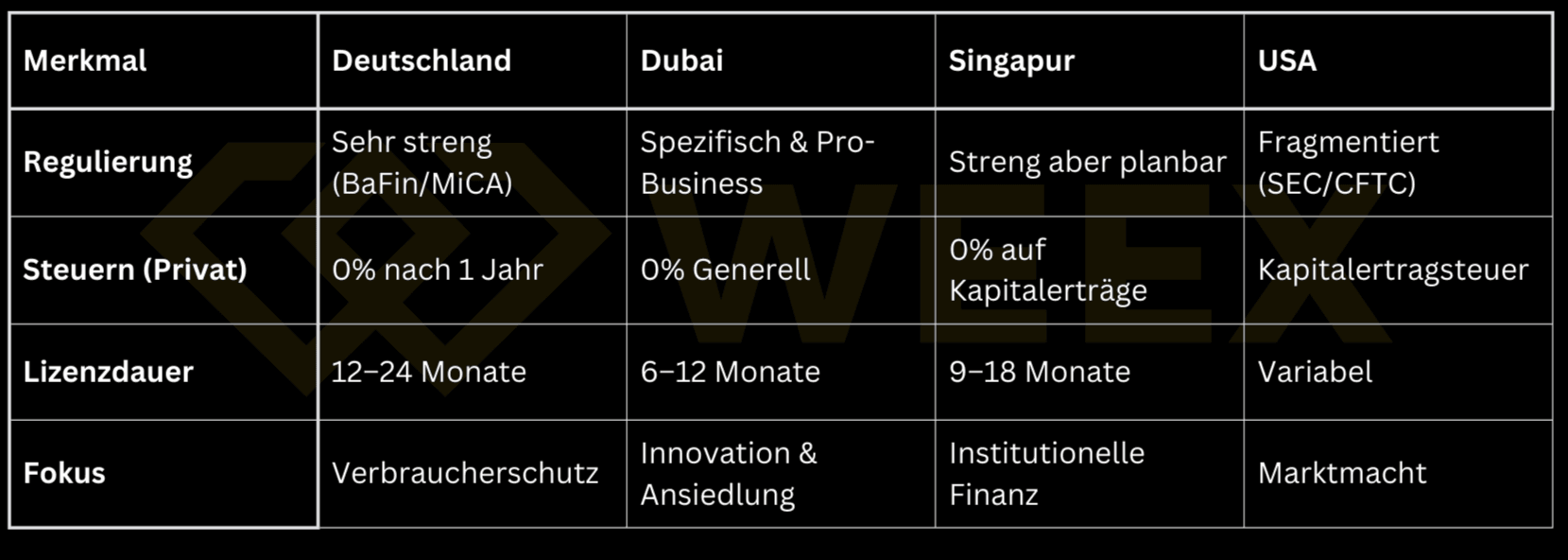
Locations like Dubai attract businesses with the specialized authority VARA (Virtual Assets Regulatory Authority) and fast approval processes, while the USA dominates due to its market size despite regulatory uncertainty.
Conclusion: Is Germany Still Competitive?
Germany continues to offer excellent conditions for private investors thanks to the 1-year rule. Legal certainty is high, and trust in licensed platforms is an important asset for conservative investors.
For companies and start-ups, however, the location has become more expensive and bureaucratic. For Germany not to lose touch with global Web3 development, experts are calling for adjustments in the implementation of MiCA and a reduction in bureaucracy.
The future will depend on whether policymakers can find a middle ground between necessary consumer protection and economic innovation.
Frequently Asked Questions (FAQ)
Is buying Bitcoin in Germany legal?
Yes, buying, owning, and trading Bitcoin and other cryptocurrencies is completely legal and regulated in Germany. Ideally, use platforms with a license for this.
Do I have to pay taxes on crypto profits?
That depends on the holding period. If you hold the cryptocurrency for longer than one year, the profit is tax-free. For a holding period of less than one year, the personal income tax rate applies (if profits exceed 600 €).
What does BaFin do in the crypto sector?
The Federal Financial Supervisory Authority (BaFin) monitors crypto service providers, issues licenses for crypto custody, and ensures compliance with anti-money laundering laws. In doing so, it protects market integrity.
What changes for German investors due to MiCA?
For investors, MiCA increases security because providers must meet stricter transparency obligations. Stablecoins are more heavily regulated to prevent a collapse like in the Terra/Luna case.
Does the 1-year rule also apply to staking?
The legal situation regarding staking was long disputed, but it was clarified by a BMF letter: The 10-year period does not apply to the underlying coins in staking; it remains at the 1-year period. However, the income from staking itself is taxable.
WEEX | Rising Star of Crypto Exchanges in the DACH Region
WEEX combines security, innovation, and community with features for beginners and professionals:
Security & Protection
- 1,000 BTC Protection Fund: Self-funded reserve for rapid loss protection in exceptional cases
Trading & Earning
- Auto Earn: Daily automatic USDT earnings without effort
- Copy-Trading: Follow elite traders automatically or apply as an elite trader for additional benefits
- WE-Launch: Early access to new projects – exclusive to WEEX users
Benefits & Rewards
- Promotions & Rewards: Trading competitions and special bonuses for active users
- Affiliate Program: Lifetime commissions from new users – details here
- VIP Benefits: Lowest fees, market insights, and personal support for high-volume traders
- WXT Token: Fee discounts, airdrops, and exclusive platform benefits
Discover current trends on WEEX Spot and start now: Register now
Disclaimer – Legal Notice from WEEX Exchange
WEEX and its affiliates offer services for the exchange of digital assets, including derivatives and margin trading, only where legal and for eligible users. All content is general information, not financial advice - seek independent advice before trading. Trading cryptocurrencies involves high risk and can lead to a total loss. By using WEEX services, you accept all associated risks and terms. Never invest more than you can afford to lose. Further information can be found in our Terms of Service and in the Risk Disclosure.