
Atkins Marks One-Year Anniversary at SEC: Crypto Regulation Shifts from ‘Enforcement Heavy’ to ‘Rulemaking Mode’

Original Title: One year under Paul Atkins, SEC's crypto stance shows break with past
Original Author: Turner Wright, Cointelegraph
Original Translation: TechFlow
TechFlow Summary: On April 21, 2025, Paul Atkins was sworn in as SEC Chairman, marking exactly one year today. During this year, the SEC dismissed multiple lawsuits against crypto companies, approved multiple crypto ETFs, and signed a digital asset regulatory coordination Memorandum of Understanding with the CFTC. However, the SEC is still awaiting Congress to pass the Market Structure Bill to clarify its jurisdiction over crypto assets.
On April 21, 2025, Paul Atkins was sworn in as the Chairman of the U.S. Securities and Exchange Commission (SEC). Today marks exactly one year since then.
During this year, the SEC has undergone a fundamental shift in its regulatory and enforcement stance on digital assets, contrasting sharply with the approach during the tenure of former Chairman Gary Gensler.
During the 2024 election, Trump made several promises to the crypto industry: replacing Gensler, establishing a national Bitcoin (BTC) reserve, and opposing the issuance of a U.S. central bank digital currency. After winning the election in November 2024, Gensler resigned in January 2025, and SEC Commissioner Mark Uyeda temporarily served as Acting Chairman until Atkins' nomination was confirmed by the Senate.
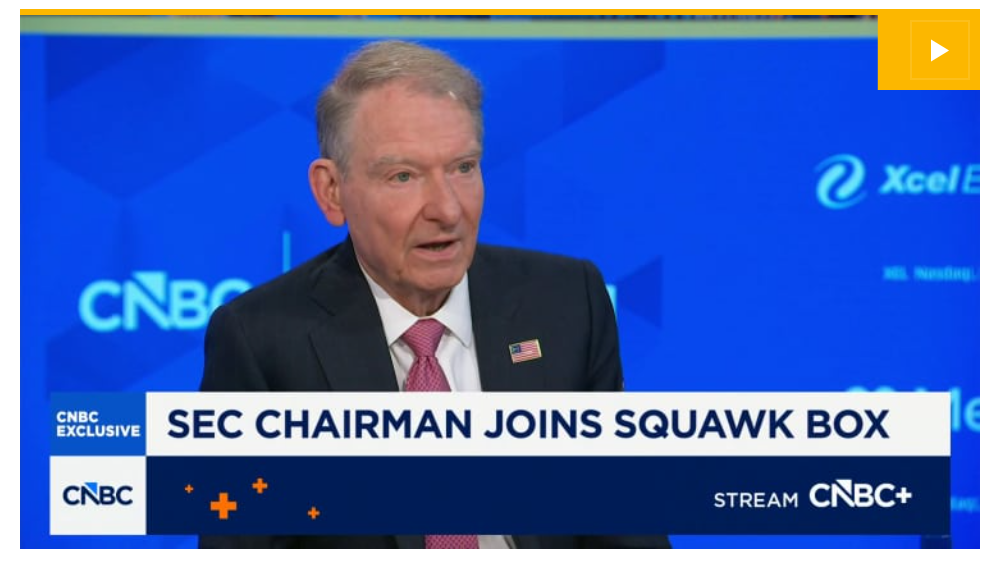
Caption: SEC Chairman Paul Atkins being interviewed on CNBC Squawk Box on April 20, 2026
SEC's Shift Began Before Atkins Took Office
Prior to Atkins' official appointment, during Uyeda's acting tenure, the SEC established a crypto working group led by Commissioner Hester Peirce and began gradually dismissing civil enforcement actions and investigations against crypto companies starting from February 2025, with Coinbase being the first.
During Atkins' first 12 months in office, the SEC rolled out a series of policies widely seen as favorable by the industry:
· Concluded multiple enforcement actions against crypto companies
· Approved several exchange-traded funds (ETFs) linked to various types of crypto assets
· Signed a memorandum of understanding on digital asset regulation with the Commodity Futures Trading Commission (CFTC)
· Issued interpretive guidance clarifying that most cryptocurrencies do not constitute securities under federal law
Speaking to CNBC on April 21, Atkins himself said, "The year went by quickly, but I feel like we've made a lot of progress. I promised a new day at the SEC when I took office, and I believe we've delivered on that. We've moved away from the past approach of regulating through enforcement and operating in a non-transparent manner, and the crypto space is the best example of that."
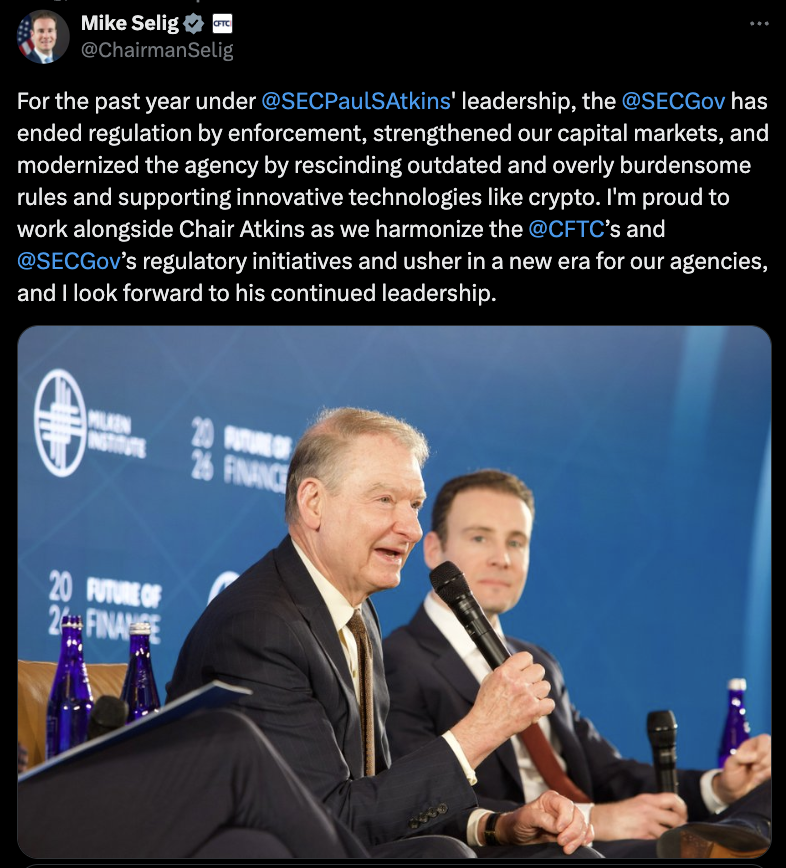
Source: CFTC Chairman Michael Selig
Democratic Lawmakers Focus on Conflict of Interest
While the crypto industry has mostly welcomed Atkins' approach, criticism from congressional Democrats is escalating. The focus is on investigations and enforcement actions revoked by the SEC that involved companies associated with Trump and his family, raising concerns about potential conflicts of interest.
Last week, Senator Elizabeth Warren of Massachusetts accused Atkins of misleading lawmakers during congressional testimony. In a letter dated April 15, Warren pointed out that SEC's own data for the 2025 fiscal year showed a decrease in the number of enforcement actions to the lowest level in a decade.
Despite the clear direction of dismissals and regulatory loosening, the SEC is still awaiting Congress to pass a market structure bill to formally clarify its regulatory boundaries over crypto assets. Until the bill is enacted, the SEC's crypto regulatory framework remains in a transitional phase of "administrative guidance + case-by-case approach."
Original Article Link
You may also like

Morning Report | Samsung announces a 265.5 trillion won investment plan, focusing on semiconductor and AI computing power data centers; Vitalik publishes an article detailing the entire technology tree behind the confusion protocol (iO) mainline
What you bought on CEX is really not US stocks: Analyzing the 94% liquidation monopoly and the evaporation of equity under a five-layer pipeline
In such a crowded cross-border payment arena, where is the next stop for the future?
Why Is Bitcoin Down in 2026? What We Can Learn From 2022
The large models in the United States are moving towards closure in the name of security
From the white-haired stock god to the billionaire fund mogul, the smart people shorting Nvidia are all getting rich using the same framework
Morning Report | CoinEx becomes a key hub for Iran to evade sanctions, involving over $3.8 billion in funds; Kalshi seeks a new round of financing, with a valuation potentially rising to $40 billion
Global Launch: As predictions become the most scarce asset in the AI era, Manadia is defining the next generation of the value internet
Why do cryptocurrency projects always like to change their names?
Who is footing the bill for the $64 billion accounting frenzy?
I never expected that the first application of AI x Crypto would be in security auditing
What is your view on Binance's competitive advantages?
ETH has entered a non-consensus phase, and the turning point is approaching!
The shift in the cloud of the air: from despising stablecoins a year ago to the high-profile entry of capital today
The survival dilemma of small and medium exchanges behind the withdrawal anomalies exposed by AscendEX
Why Is Bitcoin Falling Below $60K? 5 Key Market Drivers Explained
Bitcoin has dropped sharply amid ETF outflows, Strategy stock weakness, AI stock rallies, and changing Fed expectations. Explore the key forces driving BTC’s latest correction and what traders should watch next.
Bitcoin vs. Gold in 2026: Which Asset Performs Better in Different Markets?
The cryptocurrency industry has entered the "Show Me" era: merely relying on vision is no longer enough
Morning Report | Samsung announces a 265.5 trillion won investment plan, focusing on semiconductor and AI computing power data centers; Vitalik publishes an article detailing the entire technology tree behind the confusion protocol (iO) mainline
What you bought on CEX is really not US stocks: Analyzing the 94% liquidation monopoly and the evaporation of equity under a five-layer pipeline
In such a crowded cross-border payment arena, where is the next stop for the future?
Why Is Bitcoin Down in 2026? What We Can Learn From 2022
The large models in the United States are moving towards closure in the name of security
From the white-haired stock god to the billionaire fund mogul, the smart people shorting Nvidia are all getting rich using the same framework

Popular coins
Latest Crypto News


